Description
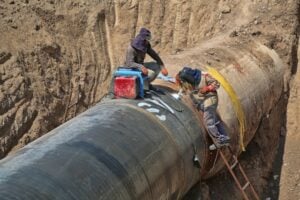
A Pipeline Engineer designs, constructs, and maintains systems used to transport fluids such as oil, gas, water, and chemicals safely and efficiently. They ensure that pipelines meet engineering, environmental, and safety standards while optimizing performance and minimizing operational costs. Pipeline Engineers play a crucial role in the energy and utilities sectors, contributing to projects that support critical infrastructure and sustainable resource distribution.
Duties
The main duties of a Pipeline Engineer include:
- Designing pipeline systems, including routing, material selection, and structural integrity analysis.
- Conducting feasibility studies, stress analyses, and hydraulic simulations to ensure pipeline reliability.
- Preparing technical drawings, project specifications, and construction documentation.
- Overseeing the installation, testing, and commissioning of pipelines and related facilities such as compressor or pumping stations.
- Monitoring pipeline performance and coordinating maintenance, inspection, and repair activities.
- Ensuring compliance with safety regulations, industry codes (such as ASME, API, or ISO), and environmental laws.
- Managing risk assessments and implementing corrosion protection, leak detection, and emergency response systems.
- Collaborating with civil, mechanical, and environmental engineers on infrastructure projects.
- Evaluating new technologies for pipeline monitoring, automation, and sustainability.
- Preparing reports and documentation for regulatory submissions and project management.
Sign in to contribute to the Duties section
Other titles
The following job titles also refer to pipeline engineer:
pipeline integrity engineer
main line station engineer
pipeline engineering technician
pipeline field technician
offshore pipeline engineer
pipeline field engineer
main line station technician
subsea pipeline engineer
Working conditions
Pipeline Engineers work in a mix of office, design, and field environments. Office work involves design, modeling, and project coordination, while field duties include supervising construction, testing, and inspections. The role may require travel to remote or offshore locations and extended periods on project sites. Work hours are generally full-time, but long or irregular hours may be necessary during project commissioning or maintenance emergencies. Fieldwork requires adherence to strict health, safety, and environmental protocols, particularly in hazardous or high-pressure systems.
Sign in to contribute to the Working conditions section
Minimum qualifications
A bachelor’s degree in mechanical, civil, or petroleum engineering is typically required for this role. A strong foundation in fluid mechanics, thermodynamics, and materials engineering is essential. Practical experience gained through internships or fieldwork in energy, utilities, or construction projects is highly valuable. Proficiency in engineering software such as AutoPIPE, Caesar II, or AutoCAD Plant 3D is advantageous. Professional certifications such as Professional Engineer (PE), Chartered Engineer (CEng), or API pipeline certifications can enhance career advancement. Success in this field requires technical accuracy, project management capability, and a commitment to safety and environmental stewardship.
Sign in to contribute to the Minimum qualifications section
Salary
Sign in to contribute to the Salary section
ISCO skill level
ISCO skill level is defined as a function of the complexity and range of tasks and duties to be performed in an occupation. It is measured on a scale from 1 to 4, with 1 the lowest level and 4 the highest, by considering:
- the nature of the work performed in an occupation in relation to the characteristic tasks and duties
- the level of formal education required for competent performance of the tasks and duties involved and
- the amount of informal on-the-job training and/or previous experience in a related occupation required for competent performance of these tasks and duties.
Pipeline engineer is a Skill level 4 occupation.
Potential next steps
No potential next step identified on the General track track for this occupation.
No potential next step identified on the Expert track track for this occupation.
How to get here
Essential knowledge and skills
Essential knowledge
This knowledge should be acquired through learning to fulfill the role of pipeline engineer.
- Engineering principles: The engineering elements like functionality, replicability, and costs in relation to the design and how they are applied in the completion of engineering projects.
- Geometry: Branch of mathematics related to questions of shape, size, relative position of figures and the properties of space.
- Technical drawings: Drawing software and the various symbols, perspectives, units of measurement, notation systems, visual styles and page layouts used in technical drawings.
- Pipeline coating properties: Know pipeline coating properties such as external anti-corrosion, internal coating, concrete weight coating, thermal insulation, and others.
- Mechanical engineering: Discipline that applies principles of physics, engineering and materials science to design, analyse, manufacture and maintain mechanical systems.
- Types of pipelines: Know various types of pipelines and their different usages. Differentiate between pipelines used to transport goods over short and long distances, and understand their respective feeding systems.
- Isometric perspective: Understand the isometric representation of three dimensional elements in two dimensional technical and engineering draughts for the manufacture, assembly, and maintenance of objects.
- Metal bending techniques: Understand different techniques for the bending of metal sheets. Connect knowledge of different techniques with activities such as assembly, design, and maintenance.
Essential skills and competences
These skills are necessary for the role of pipeline engineer.
- Ensure regulatory compliance in pipeline infrastructures: Ensure that the regulations for pipeline operations are met. Ensure pipeline infrastructure compliance with legal mandates, and compliance with regulations governing the transportation of goods via the pipelines.
- Analyse various types of water: Design boreholes; sample and analyse surface water and groundwater.
- Carry out measurements of parts: Operate measurement instruments to measure parts of manufactured objects. Take into consideration specifications of manufacturers to perform the measuring.
- Design pipelines with different coating solutions: Design pipelines envisioning different coating solutions in accordance with the goods intended for transportation. Design pipeline coating solutions following standards.
- Integrate measures in architectural designs: Integrate measurements, taken at sites or included in the project, into the design and drafting of architectural projects. Integrate considerations such as fire safety, acoustics, and building physics.
- Create designs for pipeline engineering: Design pipeline infrastructure considering engineering principles. Create blueprints, measure sites, define materials, and present functional proposals for their construction.
- Perform pipeline routing studies: Perform routing studies designed to collect information on and analyse the characteristics of the site, the challenges of construction, and other environmental factors that should be taken into consideration in planning project development.
- Consider the impact of material characteristics on pipeline flows: Consider the characteristics of goods in order to ensure that pipeline flows are uninterrupted. Anticipate the density of goods in the design of pipelines or in daily maintenance of pipeline infrastructures.
- Use measurement instruments: Use different measurement instruments depending on the property to be measured. Utilise various instruments to measure length, area, volume, speed, energy, force, and others.
- Apply health and safety standards: Adhere to standards of hygiene and safety established by respective authorities.
- Oversee wetlands in project development: Oversee and respond proactively to the challenges posed by wetlands in the development of projects. Strive to care for and conserve wetlands while finding the most environmentally cost efficient solutions for the development of infrastructure projects.
Optional knowledge and skills
Optional knowledge
This knowledge is sometimes, but not always, required for the role of pipeline engineer. However, mastering this knowledge allows you to have more opportunities for career development.
- Physics: The natural science involving the study of matter, motion, energy, force and related notions.
- Maritime transportation technology: Understand maritime transportation technology and stay up-to-date with the latest findings in the field. Apply this knowledge in operations and decision-making while on-board.
- Pipeline transport regulations;: Know about pipeline transport regulations and their application in pipeline fields. Apply pipeline transport regulations in the construction of new sites.
- CAD software: The computer-aided design (CAD) software for creating, modifying, analysing or optimising a design.
- Chemistry: The composition, structure, and properties of substances and the processes and transformations that they undergo; the uses of different chemicals and their interactions, production techniques, risk factors, and disposal methods.
Optional skills and competences
These skills and competences are sometimes, but not always, required for the role of pipeline engineer. However, mastering these skills and competences allows you to have more opportunities for career development.
- Advise on construction materials: Provide advice on and test a wide range of construction materials.
- Survey sites for pipeline installation: Perform surveys of different kinds of sites, such as inland or maritime site, for the planning and construction of pipeline infrastructure.
- Operate welding equipment: Use welding equipment to melt and join together pieces of metal or steel; wear protective eyewear during the working process.
- Detect flaws in pipeline infrastructure: Detect flaws in pipeline infrastructure during construction or over the passage of time such as construction defects, corrosion, ground movement, hot-tap made by error, and others.
- Use personal protection equipment: Make use of protection equipment according to training, instruction and manuals. Inspect the equipment and use it consistently.
- Mitigate environmental impact of pipeline projects: Strive to mitigate the potential impact that pipelines and the goods transported in them can have on the environment. Invest time and resources into consideration of the environmental effects of the pipeline, the actions that could be taken to protect the environment, and the potential increase in the costs of the project.
- Assemble manufactured pipeline parts: Assemble parts and components made for pipelines in companies or sites. Construct pipeline infrastructures or re-assemble parts that were taken out for repair. Use welding equipment and other tools in assembly activities.
- Use CAD software: Use computer-aided design (CAD) systems to assist in the creation, modification, analysis, or optimisation of a design.
- Combine multiple fields of knowledge: Combine inputs and considerations from a variety of diverse spheres (e.g. technical, design, engineering, social) in the development of projects or in the daily performance of a job.
- Maintain pipeline coating properties: Perform maintenance to pipelines and their coating properties by applying chemicals and techniques. Maintain external anti-corrosion, internal coating, concrete weight coating, thermal insulation, and other coating properties.
- Operate soldering equipment: Use soldering equipment, such as a soldering gun, a soldering torch or a gas-powered iron, to melt and join together pieces of metal or steel.
Skills group distribution
ISCO group and title
2142 – Civil engineers
References
- Pipeline engineer – ESCO
- Featured image: Photo by SELİM ARDA ERYILMAZ on Unsplash